
Many new users, when first researching Solana, ask a few recurring questions: Is SOL infinitely inflationary? What does Solana inflation actually mean? Why does SOL have inflation? Will SOL supply decline in the long run? Will SIMD-0550 change Solana's future supply model? How does SOL's tokenomics differ from ETH's?
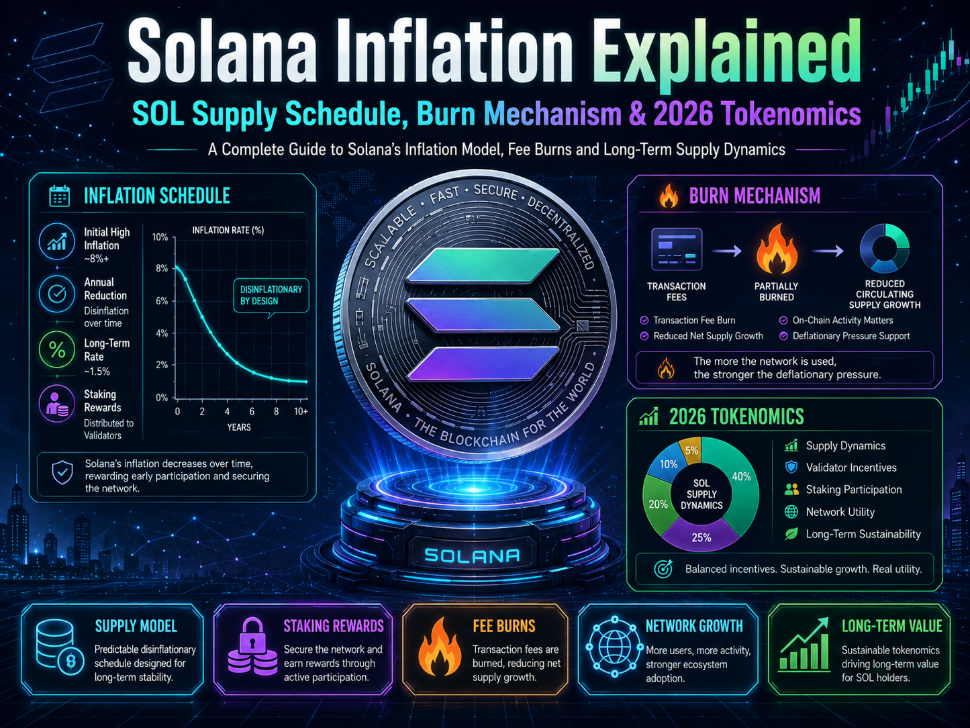
Simply put, SOL is not a fixed-supply asset at present. Solana uses a Proof-of-Stake economic model, issuing new SOL via protocol rewards to validators and stakers, thereby maintaining network security. At the same time, Solana has a fee-burning mechanism: a portion of base transaction fees is permanently destroyed. According to Solana's official documentation, the inflation schedule is defined by three core parameters: an initial inflation rate of 8%, an annual disinflation rate of 15%, and a long-term terminal inflation rate of 1.5%.
By 2026, discussions around Solana's supply model enter a more critical phase. SIMD-0550 proposes to increase the annual disinflation rate from 15% to 30%, aiming to bring Solana to its 1.5% terminal inflation rate sooner. According to the SIMD-0550 proposal, as of June 1, 2026, Solana's inflation rate is approximately 3.82%. Under the current 15% disinflation path, the terminal rate of 1.5% is projected to be reached in the first half of 2032; under the 30% path, that target could be reached as early as the first half of 2029.
This article systematically explains Solana inflation, the SOL supply model, SOL tokenomics, the burn mechanism, and how SIMD-0550 influences the future SOL supply curve.
1. What Is Solana’s Inflation Mechanism? Why Does SOL Need New Issuance?
This chapter addresses: Why isn't Solana fixed-supply? Why does SOL increase?
SOL is not just a tradeable crypto asset; it is the core economic unit of the Solana network. Users pay network fees in SOL when sending transactions, using DApps, participating in DeFi, minting assets, or interacting with smart contracts. Solana's official fee documentation states that every Solana transaction requires a SOL fee, which includes a base fee and an optional priority fee.
SOL has an even more critical function: securing the network.
Solana is a Proof-of-Stake network. Validators run nodes, process transactions, participate in consensus, and maintain network stability. SOL holders can delegate their SOL to validators, helping the network operate, and in return receive staking rewards. The official Solana staking page explains that staking yields depend on the current inflation rate, the total staking ratio, validator uptime, and commission rates.
So, SOL inflation is not simply "printing money"—it's how Solana pays for network security.
Think of it this way:
Solana network needs validators
↓
Validators require economic incentives
↓
Protocol issues new SOL
↓
Rewards validators and stakers
↓
Network security is sustained
That is the core logic behind Solana inflation.
2. What Is SOL and What Role Does It Play in the Solana Network?
SOL has three primary use cases within the Solana ecosystem.
First, paying transaction fees.
Whether you're transferring tokens, swapping, buying NFTs, using DeFi protocols, or interacting with on-chain applications, you pay SOL as network fees. Solana is designed for high throughput and low cost, so individual transaction fees are usually low, but the base fee mechanism is still needed to prevent spam and compensate validators. The official documentation states that base fees are charged per signature and are split between burning and validator rewards.
Second, participating in staking and security.
SOL holders can delegate their SOL to validators. Validators earn rewards by participating in consensus and then distribute those rewards to delegators based on commission. Most of the newly issued SOL from inflation goes to staking participants—validators and delegators. The inflation plan documentation confirms that newly issued SOL is distributed proportionally to stakeholders based on stake.
Third, supporting governance and ecosystem economics.
Protocol upgrades, validator economics, fee structures, inflation parameters, and network improvements are typically discussed through Solana Improvement Documents (SIMDs). SIMD-0550 is a key proposal regarding the future pace of Solana's inflation decline.
For those tracking SOL price and market dynamics, you can monitor SOL real-time price to better understand long-term value in the context of the supply model.
3. What Is Solana Inflation? Is SOL Inflation a Bad Thing?
This chapter addresses: Does SOL inflation necessarily mean SOL depreciates?
Solana inflation refers to new SOL being issued into the supply via protocol rewards. These new SOL primarily go to validators and stakers. It is not arbitrary nor decided by any centralized entity—it is governed by the protocol's inflation schedule.
The official Solana documentation defines the inflation plan with three parameters:
- Initial inflation rate: 8%
- Annual disinflation rate: 15%
- Long-term terminal inflation rate: 1.5%
These parameters determine the path from a higher initial inflation down to a stable long-term rate.
For newcomers, the key insight is: inflation does not equal price decline.
Price is determined by both supply and demand.
If new SOL supply grows, but network users, transaction volume, DeFi activity, developer engagement, institutional demand, and real-world applications grow even faster, the price can still rise.
If new supply keeps increasing while network demand lags, inflation could create downward price pressure.
Thus, when evaluating SOL, you should not look at inflation rate alone—you must also consider network usage, fee revenue, staking ratio, active users, DeFi TVL, and ecosystem expansion.
4. Solana’s Current Supply Model: How Much SOL Has Been Issued?
This chapter addresses: Is SOL infinitely inflationary?
Solana does not have a fixed hard cap like Bitcoin's 21 million, but that does not mean it issues SOL without rules. Solana follows a predetermined inflation curve with a long-term terminal rate. The official inflation plan explicitly states that the long-term steady-state inflation is designed to be 1.5%.
When analyzing SOL supply, investors should distinguish between several concepts:
- Circulating Supply – SOL that is currently tradeable and liquid in the market.
- Locked Supply – SOL that may be locked due to early distribution, investor arrangements, ecosystem incentives, or other reasons.
- Staked SOL – SOL that is delegated to validators. While part of the supply, it may not immediately enter secondary market circulation. A higher staking ratio can reduce short-term available supply.
- New Issuance – Protocol-level new issuance, primarily from inflation rewards, which is the main source of supply growth.
To assess SOL's price pressure, don't just look at "total supply." Instead, focus on:
Speed of new issuance
↓
Circulation release schedule
↓
Changes in staking ratio
↓
Real demand growth in the market
↓
Whether transaction and ecosystem activity can absorb new supply
5. What Is Solana’s Current Inflation Rate?
As of the data in the SIMD-0550 proposal (June 1, 2026), Solana's inflation rate is approximately 3.82%. The proposal also notes that under the current 15% annual disinflation path, it would take about 5.7 years to reach the 1.5% terminal rate.
This means that in 2026, SOL is no longer in the early 8% high-inflation phase, but has not yet reached the 1.5% terminal stage.
Think of Solana's inflation path as:
Early stage: Higher inflation to attract staking, incentivize validators, and build network security
↓
Mid stage: Inflation declines year by year, reducing new supply pressure
↓
Long-term stage: Approaches 1.5% terminal inflation, with security increasingly relying on usage, fees, and ecosystem scale
That is the core design of Solana tokenomics.
6. What Is Solana’s Long-Term Target Inflation?
Solana's long-term target inflation rate is approximately 1.5%. The official documentation refers to this as the "Long-term Inflation Rate" – the terminal inflation rate.
This is completely different from Bitcoin. Bitcoin pursues a fixed total supply and halving mechanism, with new supply trending toward zero over time. Solana, instead, chooses to retain a low level of long-term inflation to continuously support the validator ecosystem and network security.
The logic behind this design: Solana aims to maintain high performance, low fees, and mass adoption. If network fees remain very low over the long term, validators might not cover all security costs from fees alone. Protocol inflation thus provides a stable incentive for validators.
However, this also raises a critical question for investors: Can long-term low inflation be offset by network growth? Is Solana's transaction volume, user base, and ecosystem value sufficient to support SOL demand?
7. Why Does Solana Use an Inflation Model? Does Inflation Hurt SOL's Value?
This chapter addresses: Why do PoS blockchains need inflation?
Proof-of-Stake networks require validators to stay online, run nodes, process transactions, maintain network state, and bear infrastructure costs. If validator income is insufficient, validators may drop out, decentralization may suffer, node quality may decline, and network security could be compromised.
Validator income typically comes from two sources:
- Fees – transaction fees and priority fees.
- Protocol issuance rewards – new SOL from inflation.
Solana currently uses a combination of low fees + inflation rewards. Users enjoy low transaction costs, which benefits high-frequency applications, consumer apps, gaming, payments, DePIN, and large-scale on-chain interactions; validators, in turn, receive security budgets through staking rewards.
This differs from traditional monetary inflation.
Traditional inflation is usually driven by central banks and credit expansion, which can dilute purchasing power.
Crypto protocol inflation, by contrast, is a built-in issuance mechanism coded into the protocol, designed primarily to maintain network security, incentivize nodes, and support ecosystem operations.
Of course, protocol inflation still dilutes non-staking holders. If you hold SOL long-term without staking, you are theoretically diluted by new issuance. Therefore, for long-term SOL holders, understanding staking yields and the inflation rate is crucial.
8. What SOL Inflation Metrics Should Investors Watch?
Investors should not just look at the SOL inflation rate—they need a comprehensive framework.
- Supply Growth – the rate at which new SOL enters circulation. Faster growth requires more new demand to absorb it.
- Network Usage – more users, more transactions, and more active DApps mean stronger real demand for SOL.
- Fee Revenue – although Solana's per-transaction fees are low, if transaction volume scales enough, total fee revenue and validator income can still grow.
- Staking Ratio – affects staking yield and short-term circulating supply.
- Validator Health – number of validators, profitability, decentralization level, and hardware costs. If inflation drops too fast and validator income falls, it could affect the network's security budget.
- Burn – the scale of token burns. Burns can offset some issuance, but the effect depends on the fee structure and transaction volume.
9. Solana Burn Mechanism: How Does SOL Burning Reduce Supply Pressure?
This chapter addresses: Does Solana have a supply-reduction mechanism?
Yes, Solana has a fee-burning mechanism. According to the official fee documentation, the base fee for each transaction is split 50% burned and 50% paid to validators; the priority fee goes 100% to validators.
This means SOL supply change isn't just about issuance—it also depends on burn.
A simple formula:
Net Supply Change = New SOL Issuance − Burned SOL
If new issuance exceeds burns, total SOL supply increases.
If, in the future, the burn scale becomes large enough to exceed new issuance, the network could theoretically become net-deflationary.
However, in the current Solana economic model, whether burns can offset inflation depends on network usage, fee structure, and protocol parameters. The SIMD-0550 proposal itself notes that burned base fees are a very small offset to issuance in their model, so they were largely excluded from the supply model.
Thus, a more accurate statement is: Solana has a burn mechanism, but SOL is not automatically a deflationary asset because of it.
10. Issuance vs Burn Diagram – Visualizing SOL Supply Changes
A textual diagram suitable for the article:
Solana supply change mechanics:
Protocol issues new SOL
↓
Rewards validators and stakers
↓
Increases SOL supply
Users pay transaction fees
↓
50% of base fees are burned
↓
Reduces SOL supply
Final net supply change:
New issuance > Burn
↓
SOL supply increases
New issuance < Burn
↓
SOL supply decreases
Currently, Solana is closer to the first state: it remains an inflationary asset, but the inflation rate is declining. The core significance of SIMD-0550 is to accelerate the decline of new issuance, not to burn existing SOL directly.
11. SIMD-0550: How Will Solana’s Future Supply Curve Change?
This chapter addresses: How will SIMD-0550 change the SOL supply model?
SIMD stands for Solana Improvement Document – similar to Ethereum's EIPs – used to discuss protocol upgrades, parameter adjustments, economic model changes, and technical improvements.
The core change proposed by SIMD-0550 is straightforward: increase the annual disinflation rate from 15% to 30%.
Here, disinflation is not deflation.
Deflation means total supply decreases.
Disinflation means the rate of inflation decreases – the speed at which prices (or in this case, supply growth) slows down.
In other words, SIMD-0550 does not directly reduce existing SOL, nor does it instantly make SOL deflationary. It makes future new SOL issuance slow down faster.
Think of it as:
Current path: Inflation rate drops 15% per year → Slower approach to 1.5% terminal inflation
SIMD-0550 path: Inflation rate drops 30% per year → Faster approach to 1.5% terminal inflation
According to the proposal, under the current path, terminal inflation is expected in the first half of 2032; under the new path, it could be reached in the first half of 2029.
12. Potential Long-Term Impacts of SIMD-0550
SIMD-0550 has implications for investors, validators, and the ecosystem.
For investors: The most direct effect is lower future new-supply pressure. The proposal's model shows that with 30% disinflation, total supply after six years is estimated at ~708.54 million SOL – about 18.9 million SOL lower than under the current path, a difference of roughly 2.6%.
For validators: Inflation rewards decline faster. The proposal estimates that nominal staking yield could drop from the current ~5.84% to 4.34% in year one, 3.00% in year two, and 2.25% in year three.
For the Solana ecosystem: The long-term question is: if inflation rewards fall, the network will need more fees, MEV, priority fees, and real application revenue to support validator economics.
Thus, SIMD-0550 is not simply a "bullish for price" proposal. Its essence is to rebalance three factors:
Reduce new supply pressure
↓
Lower staking rewards
↓
Push network revenue to bear more security costs
If Solana's ecosystem grows fast enough, this could improve SOL tokenomics quality.
If ecosystem revenue is insufficient, lower validator income could become a new risk factor.
13. Inflation Timeline – Solana’s Inflation Roadmap
A textual timeline for the article:
Solana inflation design path:
Initial phase
Inflation Rate: 8%
Goal: incentivize validators, attract staking, build network security
Declining phase
Disinflation Rate: 15% per year
Goal: gradually reduce new supply pressure
2026 phase
Inflation Rate: ~3.82%
Status: still inflationary, but well below early levels
SIMD-0550 proposed path
Disinflation Rate: from 15% to 30%
Goal: reach terminal inflation sooner
Long-term phase
Terminal Inflation Rate: 1.5%
Goal: low inflation to sustain network security
Note that as of the proposal document, SIMD-0550 is still in discussion and governance process. The proposal page indicates it is under discussion and expected to move to voting once new governance tools are ready.
14. SOL Supply Curve – How to Read It
A textual chart for publication:
The SOL supply curve is not a sudden drop—it's a curve that still rises, but with a gradually flattening slope.
Current model:
SOL Total Supply ↗ continues to increase
Inflation Rate ↘ declines year by year
New SOL amount ↘ decreases year by year
SIMD-0550 model:
SOL Total Supply ↗ still increases
Inflation Rate ↘↘ declines faster
New SOL amount ↘↘ declines faster
Long-term effect:
Supply may still grow, but at a slower pace
Lower supply pressure
Token economics closer to a low-inflation asset
This is the key to understanding SOL supply forecast for 2026: SOL is not instantly deflationary, but transitions from higher inflation to low inflation.
15. Solana vs Ethereum – Two Different Tokenomic Models
This chapter addresses: Which economic model is better, SOL or ETH?
It's not fair to simply say one is better – they have different design goals.
Ethereum – after The Merge, it shifted to Proof-of-Stake. ETH supply is driven by two forces: PoS issuance and EIP-1559 burns. Ethereum's official documentation explains that ETH supply can be broken down into issuance and burn; when network demand is high, burns can offset or even exceed issuance.
EIP-1559's core is base fee burning – burning the base fee instead of paying it all to block producers. The EIP-1559 documentation states that base fee burns can counterbalance Ethereum inflation.
Thus, ETH emphasizes value capture: the busier the network, the higher the fees, the more burns, and the more supply pressure may decline. Users can monitor ETH price predictions to observe Ethereum's ecosystem and ETH asset logic.
Solana has a different focus. Solana prioritizes high performance, low cost, and mass adoption. It does not want fees to remain high long-term; instead, it attracts high-frequency applications and large user bases through low fees, while using inflation rewards to support validator economics.
In a nutshell:
ETH is more like a high-value settlement layer, emphasizing security, scarcity, and fee burning.
SOL is more like a high-performance application layer, emphasizing low cost, high throughput, and ecosystem expansion.
16. SOL vs ETH Tokenomics Comparison – Textual Comparison Module
ETH economic model:
PoS issuance → rewards validators
EIP-1559 burn → destroys base fees
Stronger network demand → higher fees → more ETH burned → more pronounced value capture
SOL economic model:
Protocol inflation issuance → rewards validators and stakers
Low-cost transactions → attract high-frequency apps and users
Partial base fee burns → offset a small amount of supply growth
Stronger network demand → larger ecosystem → potential increase in SOL demand
Investment logic differences:
ETH focus: settlement security, fee burning, Layer 2 ecosystems, institutional adoption
SOL focus: user growth, transaction volume, application ecosystem, low-fee experience, supply decline path
17. How Does the SOL Supply Model Affect Long-Term Investment Value?
This chapter addresses: What is the relationship between supply model and price?
Lower supply does not automatically drive price up.
This is a crucial point for investors.
Price is determined not by supply alone, but by both supply and demand.
If SOL supply growth slows, but user demand also drops, price may not rise.
If SOL supply is still growing, but users, transaction volume, DeFi, RWA, payments, DePIN, AI applications, and institutional demand grow faster, price can still rise.
Therefore, when analyzing SOL's future value, monitor five directions:
- Solana user growth – active addresses, real users, wallet interactions, and consumer apps drive stronger SOL demand.
- On-chain transaction volume – Solana's edge is high throughput and low cost; sustained volume growth shows the network's positioning is working.
- DeFi ecosystem scale – DeFi TVL, DEX volume, lending demand, stablecoin circulation, and yield products affect SOL's ecosystem value.
- Validator health – stable validator count, sustainable profitability, and good decentralization make Solana's security model more reliable.
- Token supply growth rate – faster disinflation lowers supply pressure, but also requires watching whether validator incentives remain sufficient.
18. How Does Solana Tokenomics Differ from Emerging Crypto Projects?
This chapter helps users build analytical skills for crypto projects.
Different tokens derive value from completely different sources; you cannot just look at price.
SOL is a Layer-1 blockchain asset. Its value comes from network usage, validator security, ecosystem applications, developer activity, fee mechanisms, and supply management.
AI crypto projects – for example, what is SKYAI – focus more on AI applications, on-chain data, AI agents, and Web3 intelligent services.
RWA assets – e.g., what is AIRH – focus on AI Robotics, tokenization of traditional assets, and real-world asset financialization.
Web3 trading infrastructure – e.g., what is GRVT – focuses on self-custodial trading, ZK tech, RWA trading, and on-chain wealth management.
Early-stage tokens – often rely more on community, liquidity, and narratives. For example, you can track FRONG price and FRONG price prediction to observe small-cap token market movements.
For investors, the core question is not "which token is cheapest," but:
Is the supply model healthy?
Is demand growth real?
Is ecosystem value sustainable?
Does the token capture network value?
Is the market willing to price in future growth?
19. How to Analyze SOL Supply Changes – A Practical Framework
A four-dimensional framework for analyzing SOL supply:
1. Supply – inflation rate, circulating supply, total supply, staking ratio, locked supply, and future issuance pace.
2. Demand – active users, transactions, DeFi TVL, DEX volume, stablecoin scale, NFT and consumer app activity.
3. Security – validator count, staking ratio, validator profitability, network stability, and decentralization level.
4. Market – Bitcoin cycles, ETH trends, crypto capital flows, Solana ecosystem hotspots, institutional money, and macroeconomic liquidity.
If supply growth declines while demand growth rises, that's Solana's most ideal economic state.
If supply slows but ecosystem demand is insufficient, you cannot simply interpret that as a long-term positive.
20. FAQ – Common Questions About Solana Inflation
Is Solana inflationary?
Yes. Solana is currently an inflationary asset – the protocol issues new SOL to reward validators and stakers. However, the inflation rate declines over time, with a long-term target of 1.5%.
Does Solana have unlimited supply?
Solana does not have a fixed hard cap like Bitcoin, but it does not issue SOL without rules. It follows a predetermined inflation schedule defined by the initial rate, annual disinflation rate, and long-term terminal rate.
What is Solana's inflation rate in 2026?
According to the SIMD-0550 proposal data, as of June 1, 2026, Solana's inflation rate is approximately 3.82%. Real-time inflation may vary by epoch; investors should consult on-chain data and official tools for the latest figures.
Will SIMD-0550 make SOL deflationary?
Not necessarily. SIMD-0550's core is to accelerate disinflation – reducing the pace of future new SOL issuance – not to directly reduce existing supply. It may bring Solana to its 1.5% terminal inflation sooner, but that does not instantly make SOL deflationary.
How does Solana's burn mechanism work?
For each transaction, 50% of the base fee is burned and 50% goes to validators; the optional priority fee goes 100% to validators.
Is SOL better than ETH?
It depends on your investment thesis. ETH emphasizes settlement security, EIP-1559 fee burning, and value capture; SOL emphasizes high performance, low cost, mass adoption, and ecosystem growth. They are not the same economic model and should not be compared on a single metric.
Does staking SOL offset inflation?
For staking participants, staking rewards can partially or fully offset inflationary dilution, depending on the network inflation rate, total staking ratio, validator performance, and commission. The official Solana staking page explains that yield is affected by current inflation, total staked proportion, validator uptime, and commission.
21. Summary – The Core of Solana’s Supply Model Is Not “Infinite Inflation” but “Disinflation + Ecosystem Growth”
Solana's tokenomics can be summarized in one sentence: SOL pays for network security through protocol inflation, reduces new supply pressure through annual disinflation, offsets some supply growth through partial fee burning, and relies on ecosystem expansion to drive long-term demand.
Currently, SOL remains an inflationary asset, but the inflation rate has already dropped from the initial 8% to approximately 3.82% in 2026. Solana's long-term target is 1.5%. If SIMD-0550 is adopted, Solana will increase the annual disinflation rate from 15% to 30%, reaching terminal inflation sooner and reducing new issuance by about 18.9 million SOL over the next six years.
But investors cannot look only at supply reduction. SOL's future value also depends on whether Solana can consistently attract users, developers, DeFi capital, consumer applications, payment use cases, RWA assets, and institutional money.
If Solana's ecosystem grows faster than supply, SOL tokenomics become more attractive.
If ecosystem growth falls short, even lower inflation may not support price.
Thus, the real significance of studying Solana inflation is not simply deciding whether SOL is "infinitely inflationary," but understanding how Solana balances network security, validator incentives, low-fee user experience, supply management, and long-term value capture.