
AI is becoming one of the most important new narratives in the crypto market. In the past, the core keywords were Bitcoin, Ethereum, DeFi, NFTs, and memes. Today, more and more investors are turning their attention to AI crypto, AI agents, decentralized data, compute networks, and AI-powered financial applications.
SKYAI has entered the market spotlight against this backdrop. Many people searching for “what is SKYAI,” “what is SKYAI coin,” or “how to buy SKYAI” for the first time usually want to know: Is SKYAI really an AI coin? What real-world use does it have? Why might the SKYAI token have value? Will it go up in the future? And how should beginners assess the risks?
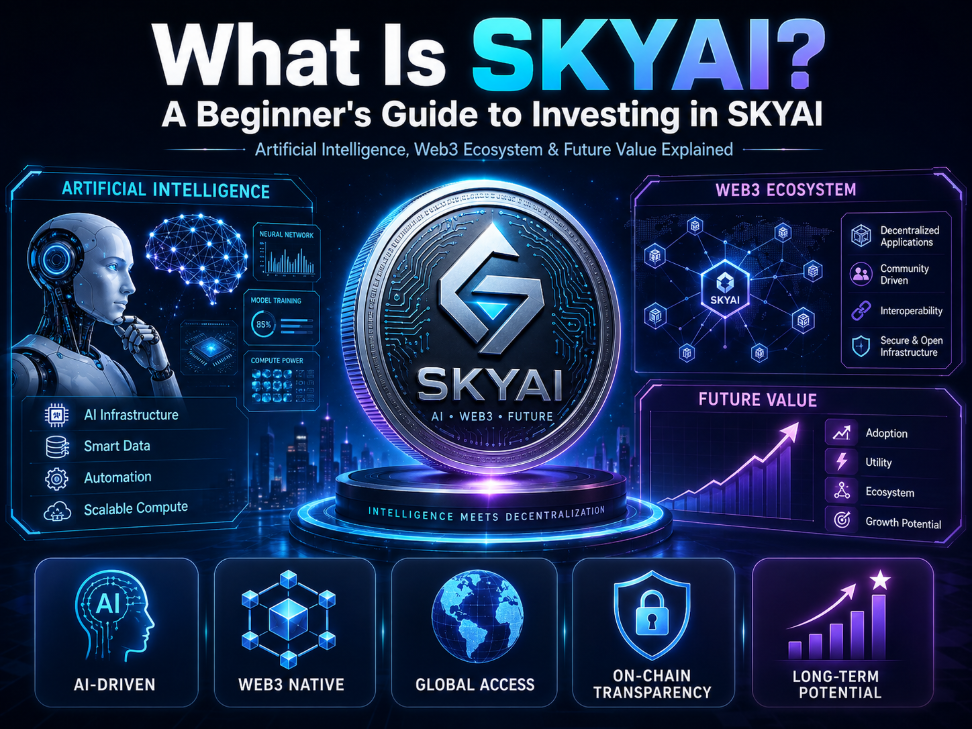
Simply put, SKYAI is a digital asset in the AI + blockchain space. It is not an ordinary AI software product, nor is it a traditional tech stock. Rather, it is an AI crypto project built around AI-blockchain data interaction, Web3 ecosystem applications, and token economic design. According to its CoinMarketCap page, SKYAI is positioned as an MCP-driven all-in-one AI ecosystem that aims to provide multi-chain data services for large language models and AI agents, supporting data sets on chains like BNB Chain and Solana.
This article provides a systematic analysis of SKYAI’s investment thesis, covering: what SKYAI is, why AI crypto is gaining traction, the sources of SKYAI token value, its tokenomics, price predictions, purchase procedures, and investment risks.
1. What Is SKYAI? And Why Is AI Crypto Getting So Much Attention?
This section answers the most common first questions: “What exactly is SKYAI?” and “Why is it related to AI?”
SKYAI can be understood as a Web3 AI ecosystem asset in the AI + blockchain space. Its core narrative is not simply putting “AI” in the project name; rather, it aims to help AI systems better understand, read, and use blockchain data.
From its positioning, SKYAI is tied to AI agents, on-chain data, the MCP protocol, multi-chain ecosystems, and data service marketplaces. CoinMarketCap data shows that SKYAI proposes an extended version of MCP (Model Context Protocol) to create multi-chain data services for large language models, with plans to build an MCP marketplace that fosters an on-chain data economy.
Thus, SKYAI is not a generic AI application, not a traditional stock, and not a typical meme coin. It is best categorized as a Web3 AI ecosystem asset — a token project within the AI crypto sector.
To check SKYAI’s current market performance, you can visit the SKYAI real-time price and trading data page for price, changes, volume, and trading activity.
2. Why Is AI Becoming the New Narrative in Crypto?
The early crypto market had very clear themes.
Bitcoin represented digital gold, solving decentralized value storage.
Ethereum brought smart contracts, powering DeFi, NFTs, DAOs, and on-chain applications.
DeFi enabled on-chain finance, allowing users to trade, lend, stake, and manage yields without traditional banks.
Now, AI crypto is emerging as the next major theme. The reason is that AI and blockchain — while seemingly separate — have natural synergies in data, compute, payments, identity, automation, and incentive design.
- AI needs vast amounts of data; blockchains offer public, verifiable, and continuously updated on-chain data.
- AI needs computing power; decentralized networks can use tokens to incentivize more compute providers, nodes, and resource contributors.
- In the future, AI agents may autonomously execute tasks — automated trading, payments, service calls, and fund management. To enable this, programmable payment networks, identity systems, permission management, and token settlement layers are essential.
This is why AI crypto projects are attracting attention. The market isn’t just buying into an “AI buzzword” — it’s asking: if AI becomes the gateway to the future internet, can blockchain become the settlement layer, data layer, and incentive layer for the AI economy?
3. Why Do AI and Blockchain Actually Converge?
This section addresses the real connection between AI and blockchain.
First, AI needs better data inputs.
For large language models and AI agents to function effectively in crypto, they need to understand on-chain transactions, address behaviors, asset flows, smart contract interactions, DeFi protocol states, and multi-chain data changes. Generic AI models cannot make reliable judgments if they can’t read structured on-chain data. According to Bybit Learn, SkyAI extends MCP to convert blockchain data into structured formats that AI models can more easily understand and analyze, aggregating data from BNB Chain, Solana, and other chains.
Second, AI needs economic incentive systems.
AI services are not free. Data providers, compute providers, model developers, application builders, and users need a system that can settle automatically, record transparently, and circulate across platforms. Tokens can serve as payment, rewards, governance, and ecosystem incentives.
Third, AI agents need programmable financial infrastructure.
Future AI agents won’t just answer questions — they will proactively perform tasks: analyzing on-chain data, monitoring wallet risks, executing trading strategies, calling DeFi protocols, managing subscriptions, and executing cross-chain operations. For agents to act on-chain, they need wallets, smart contracts, permission systems, and payment rails.
SKYAI sits squarely within this AI crypto direction, addressing these very needs.
4. What Problem Does SKYAI Solve? Where Does Its Value Come From?
This section answers: Why do we need SKYAI?
The traditional AI industry has three clear pain points.
First, data centralization.
Large amounts of high-quality data are locked in centralized platforms. Ordinary users, developers, and small teams struggle to access usable data. In crypto, while on-chain data is public, it is not readily interpretable — raw data is complex, fragmented, and non-standardized, requiring specialized processing for AI models.
Second, high compute and service costs.
AI training and inference are compute-intensive. Average users have little opportunity to directly participate in the AI economy; they mostly consume AI services from large platforms without sharing in the upside.
Third, AI applications lack open economic systems.
Traditional AI products use subscription or API-pay models. Users pay centralized platforms, developers depend on platform rules, and data providers have little transparent revenue. Web3’s value lies in redesigning the distribution of value among data, services, resources, and user contributions via token mechanisms.
SKYAI aims to address these through an AI service network, AI data services, AI-agent-to-blockchain interaction, and Web3 incentive structures.
If SKYAI can make it easier for AI developers to call multi-chain data, enable data providers to earn through an MCP marketplace, and allow users to analyze on-chain information via natural language, then its token value could derive from real usage demand — not just market hype.
5. What Type of AI Crypto Project Is SKYAI?
This section clarifies how SKYAI differs from generic “AI coins.”
AI crypto is not a single vertical; it comprises several sub-sectors:
1. AI compute infrastructure – GPU networks, decentralized compute, inference networks, and model training resources, addressing compute scarcity and cost.
2. AI data networks – data collection, labeling, rights management, trading, and on-chain data indexing. Since AI quality depends heavily on data, this is a critical segment.
3. AI agent ecosystems – autonomous agents that perform trading, payments, research, on-chain monitoring, risk management, automated operations, and DeFi strategy execution.
4. AI + finance – automated trading, robo-advisory, on-chain risk analytics, AI quant strategies, wallet security assistants, and DeFi data analytics.
Based on current public information, SKYAI leans more toward AI data services and AI agent infrastructure. It emphasizes MCP, multi-chain data, AI model understanding of on-chain information, and a future data marketplace. This differentiates it from pure AI chatbot projects or meme-style AI tokens.
6. What Value Does the SKYAI Token Have? What Are Investors Actually Buying?
Investing in SKYAI token is not about buying an AI software product or a company stock — it’s a bet on whether the SKYAI ecosystem will generate real demand.
SKYAI token may have several use cases:
1. Ecosystem payments – If data services, AI applications, MCP calls, developer tools, or on-chain analytics within the ecosystem require token payments, SKYAI could see baseline demand.
2. Network incentives – Data providers, node operators, developers, and contributors could earn SKYAI rewards for providing services, incentivizing network growth.
3. Governance rights – If SKYAI transitions toward DAO governance, token holders may participate in decisions on parameters, market rules, fund allocation, and protocol upgrades. Bybit Learn notes that SKYAI’s roadmap includes a future shift to DAO governance.
4. Marketplace settlement – If the MCP marketplace becomes a functioning data-service trading venue, the token could serve as a primary medium for purchasing data, consuming resources, and settling platform transactions.
Thus, the core value-creation logic for SKYAI token is: user growth → ecosystem expansion → increased real service demand → greater token utility.
Without real users and application demand, prices will likely remain sentiment-driven. Sustainable ecosystem growth, however, can provide longer-term support.
7. AI Crypto and the RWA Trend: Why Are Traditional Assets Moving On-Chain?
AI crypto is one major direction; RWA (Real World Assets) is another. RWA involves tokenizing real-world assets like stocks, ETFs, commodities, bonds, funds, real estate, and more.
The significance of RWA is that it allows traditional financial assets to enter crypto markets via blockchain. Users can gain exposure to certain real-world assets through USDT, on-chain wallets, or crypto exchanges, without relying solely on traditional brokerage accounts.
AI assets and RWA could also converge in the future — for example, AI company equity, AI infrastructure yields, robotics assets, compute leasing revenues, and data asset income could all be tokenized and enter on-chain financial markets.
To better understand the tokenization of traditional financial assets, you can read what is SOXSB and what is PYPLB. These explain how stocks, ETFs, corporate assets, and RWA are entering the crypto space.
While SKYAI is primarily an AI crypto project, the broader Web3 ecosystem it belongs to may increasingly intersect with RWA, DeFi, AI agents, and on-chain asset management.
8. SKYAI Tokenomics Analysis
Tokenomics is critical when evaluating SKYAI. Many beginners only look at price, ignoring supply, circulating supply, FDV, and unlock schedules.
According to CoinMarketCap data (as of page capture), SKYAI has a circulating supply and a maximum supply of 1 billion tokens. Bybit Learn also describes SKYAI as a BEP-20 token with a total supply of 1 billion.
But total supply is just the starting point. Investors should also monitor:
Market cap – helps gauge the project’s current size. If the cap is already high while the product is still early, price may have already priced in too much expectation.
FDV (Fully Diluted Valuation) – for new tokens, FDV is often more telling than current market cap. If large token unlocks loom, a high FDV can signal downside risk.
Trading volume – reflects market interest. Rising SKYAI/USDT volume indicates growing attention; falling volume means price moves may be more easily swayed by small orders.
Holder addresses – can indicate decentralization. If tokens are concentrated in a few wallets, price is more vulnerable to large holders.
Unlock schedule – unlocks are a major price factor. If team, institutional, ecosystem, or early participant tokens are released at the same time, selling pressure may spike. Always check unlock dates before buying.
9. SKYAI Price Prediction: Upside Factors and Risks
A precise price prediction is impossible. AI crypto is highly volatile, and new project prices depend on market cycles, exchange liquidity, project milestones, AI sector sentiment, token unlocks, and more.
You can view SKYAI price prediction for trend references, but never treat any prediction as guaranteed returns.
Potential upside drivers:
1. AI sector growth – If AI remains a core narrative in tech and crypto, AI tokens may continue attracting capital — particularly projects tied to AI agents, data services, compute, automated trading, and on-chain analytics.
2. Crypto bull cycles – When BTC and ETH are strong, risk appetite rises, and capital often rotates from majors into AI, RWA, DePIN, DeFi, and smaller-cap tokens. SKYAI could benefit from sector rotation.
3. Ecosystem development – If SKYAI consistently delivers products, expands multi-chain data coverage, attracts developers, builds a functioning MCP marketplace, and integrates the token into payments and incentives, its value foundation strengthens.
Key risks:
1. Intense competition – Established AI crypto projects like Fetch.ai, Render, and Bittensor, plus many newcomers, crowd the field. SKYAI must prove differentiation in tech, data services, user adoption, and partnerships.
2. Execution risk – AI + blockchain is promising, but many projects remain early-stage. Academic research also warns that AI token projects often face off-chain compute dependencies, scalability issues, and homogeneous business models.
3. Liquidity risk – Small-cap or early tokens tend to be highly volatile. Thin order books can cause significant slippage.
10. How to Buy SKYAI: Beginner Step-by-Step
Step 1: Check the SKYAI market page.
Start at the SKYAI real-time price and trading data page to see current price, changes, volume, and trends.
Step 2: Prepare a trading account.
If SKYAI is listed on your chosen exchange, register and complete security settings. Enable two-factor authentication, use strong passwords, and never share verification codes, private keys, or seed phrases.
Step 3: Obtain USDT.
Most AI tokens trade against USDT. USDT offers stable pricing, global liquidity, and easy cross-platform transfers. Start with a small deposit or purchase, and confirm receipt before trading.
Step 4: Search for the SKYAI trading pair.
On the exchange, search “SKYAI” or “SKYAI/USDT” and enter the correct trading page. Double-check the pair name, platform announcements, and liquidity to avoid fake assets or phishing links.
Step 5: Choose order type.
Beginners are better off using limit orders rather than market orders. AI tokens can be volatile; if order-book depth is thin, market orders may incur significant slippage.
Step 6: Manage position size.
SKYAI is a high-volatility crypto asset — avoid heavy bets. A more rational approach is to start with a small position, scale in gradually, and adjust based on project progress, tokenomics, and market cycles.
11. Why Are AI Tokens Usually Traded Against USDT?
USDT is one of the most common stablecoins in crypto, and many pairs (BTC/USDT, ETH/USDT, SKYAI/USDT) are quoted against it.
For beginners, USDT acts like a “settlement currency” in crypto markets. You can hold USDT and switch into different tokens as opportunities arise — more flexible than direct fiat trading, and convenient for cross-platform transfers and risk management.
However, USDT is not without risk. Stablecoins depend on issuer reserves, regulatory environment, on-chain liquidity, and platform support. In extreme market conditions, stablecoins can experience short-term price deviations.
12. How SKYAI Differs from Other Popular Crypto Assets
SKYAI vs. other AI crypto projects – SKYAI emphasizes the bridge between on-chain data and AI models. Some AI tokens focus on compute (e.g., decentralized GPU networks), others on models (agents, automation), and others on data (labeling, trading, analytics). SKYAI is closer to AI data infrastructure and AI agent tooling. Its key competitive edge should be assessed by MCP protocol expansion, multi-chain data coverage, marketplace activity, developer adoption, and real user demand.
SKYAI vs. RWA tokens – SKYAI is AI crypto; RWA tokens represent tokenized real-world assets (stocks, ETFs, commodities, etc.). To understand different asset classes, you can read what is MARSCOIN and what is SMHB.
In short:
- SKYAI → AI ecosystem token
- RWA token → real-world asset tokenization
- Meme token → community sentiment and virality
- DeFi token → financial protocol utility
Investors must match investment logic to asset type, rather than treating all crypto projects the same.
13. How the ETH Ecosystem Affects SKYAI’s Development
Even if SKYAI isn’t fully dependent on Ethereum, ETH remains one of crypto’s most foundational assets. The Ethereum ecosystem influences DeFi liquidity, on-chain user base, new token issuance, Layer 2 growth, and overall risk appetite.
When the ETH ecosystem is vibrant, more capital flows into DeFi, AI, RWA, and on-chain apps, and markets are more willing to explore new projects. Conversely, when ETH and major assets are weak, smaller-cap AI tokens often experience greater volatility.
Thus, investing in SKYAI requires monitoring not just the project itself, but also BTC, ETH, and the broader crypto market cycle. You can check ETH price prediction to gauge whether the environment favors AI crypto.
14. What Are the Risks of Investing in SKYAI?
Technical risk – SKYAI involves AI, MCP, multi-chain data, blockchain infrastructure, and tokenomics. Any shortfall in execution — AI models failing to truly understand on-chain data, unstable data services, or lack of developer interest — can hurt the project.
Market risk – Crypto is highly volatile. SKYAI prices are influenced by BTC cycles, ETH trends, macro liquidity, AI sector sentiment, and exchange capital flows. Even with project progress, prices can retreat during market downturns.
Competition risk – The AI crypto space is already crowded with established names (Fetch.ai, Render, Bittensor) and continuous new entrants. SKYAI must prove product differentiation to avoid being overlooked.
Token risk – New tokens often face high volatility, low liquidity, concentrated holdings, unlock pressures, and short-term speculation. Pay close attention to circulating supply, FDV, unlock schedules, and order-book depth.
Hype risk – AI is a powerful narrative, but strong narratives also attract speculative capital. Many token rallies occur not because of real application growth, but due to temporary sentiment. Beginners buying solely on “AI buzz” may end up taking on risk at elevated levels.
Regulatory risk – AI, data, token payments, stablecoins, and cross-border finance may face regulatory changes. Different countries have varying rules on crypto assets, AI data services, and token trading; future policy shifts could affect project development and user participation.
15. Future Outlook: Will AI + Blockchain Become Next-Gen Infrastructure?
Over the long term, SKYAI’s opportunity rests on three trends:
1. The AI agent economy – Future AI agents won’t just chat; they will execute real tasks — managing funds, executing trades, analyzing on-chain data, calling APIs, purchasing services, making payments, and interacting with DeFi protocols. Such economic activity requires on-chain identity, token settlement, permission systems, and data interfaces.
2. Tokenization of AI assets – AI capabilities, data resources, model services, compute power, and automation tools may all be financialized and tokenized. Users won’t just use AI — they may participate in AI ecosystem growth via tokens.
3. Web3 infrastructure maturity – Crypto is moving from pure speculation toward more complex applications. DeFi, RWA, AI, DePIN, on-chain identity, and account abstraction could collectively drive next-generation Web3 applications. If SKYAI becomes a key infrastructure for AI to read and use on-chain data, its long-term value becomes clearer.
However, long-term potential does not guarantee success. SKYAI still needs to prove product delivery, user growth, ecosystem partnerships, developer adoption, and token demand.
16. Conclusion: Is SKYAI Worth Investing In?
SKYAI is worth watching, but it should not be dismissed as “an AI concept coin that will definitely go up.”
Strengths:
- Positioned on the long-term AI trend — AI is reshaping the internet, finance, data, and automation, and AI crypto may become a major narrative in the next cycle.
- Focused on a genuine Web3 innovation — connecting AI with on-chain data, multi-chain ecosystems, MCP, and AI agents, rather than just a generic AI app.
- Early-stage growth potential — if ecosystem applications, user numbers, data services, and token utility continue to grow, SKYAI could gain stronger market recognition.
Risks:
- Fierce competition in AI crypto, with both strong incumbents and new entrants.
- Still needs to prove product-market fit and real user demand.
- Token prices are highly volatile and susceptible to market cycles and AI sentiment swings.
For beginners, four key areas to focus on before investing:
- Product progress – Has SKYAI launched a usable product? Are there real users? Is development ongoing?
- User growth – Are AI data services, the MCP marketplace, developer ecosystem, and community activity increasing?
- Tokenomics – Pay close attention to supply, circulating supply, FDV, unlock schedules, and holder distribution.
- Market liquidity – Monitor SKYAI/USDT volume, bid-ask spreads, order-book depth, and exchange support.
A rational approach: start by checking current market data on the SKYAI real-time price page, then cross-reference with SKYAI price prediction, ETH price prediction, what is SOXSB, what is PYPLB, what is MARSCOIN, and what is SMHB to build a well-rounded crypto investment knowledge base.
SKYAI can serve as a case study in the AI crypto sector, but whether it’s a worthwhile investment depends on its ability to translate the AI narrative into real products, real users, and real token demand. For investors, the most important thing is not chasing hype, but finding genuine data and logic behind the story.