
As RWA assets, tokenized stocks, and stablecoin trading markets continue to evolve, more and more traditional financial assets are making their way into the crypto ecosystem. In the past, investing in U.S. stocks meant opening a brokerage account, funding it with fiat currency, and waiting for market hours. Today, several platforms offer tokenized stock assets priced in USDT, giving crypto users exposure to U.S. equity prices directly from their digital asset wallets.
SMHB is one such asset.
Most users encountering SMHB for the first time have the same questions: What exactly is SMHB? Is it a cryptocurrency issued by Starbucks? How does it differ from the ordinary SBUX stock? How do you buy it? And will it go up?
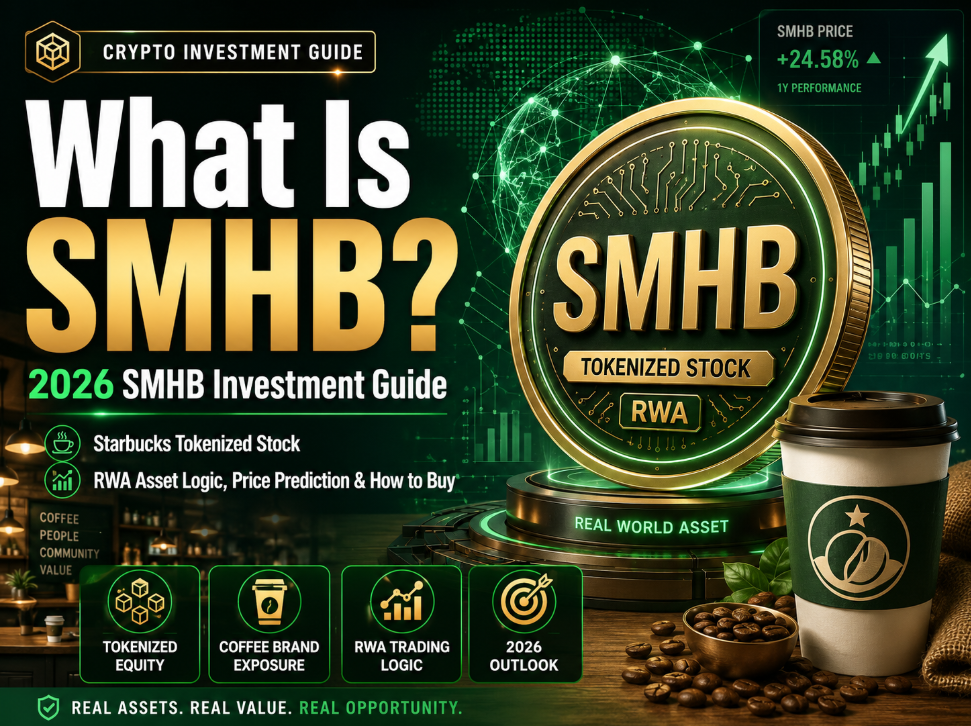
Simply put, SMHB is a Starbucks-linked tokenized stock asset that falls under the RWA (Real World Assets) category. It is not an official Starbucks-issued digital currency, nor is it a Starbucks payment token. Instead, it is a digital representation of a traditional equity asset, designed for trading within a blockchain-based environment.
You can check SMHB’s live price, trading data, and market performance on HIBT:
SMHB Real-Time Quotes:
https://hibt.com/quotes/SMHB-USDT
Keep in mind that tokenized Starbucks stocks may appear under different tickers across exchanges—for example, SBUXON or SBUXx. Kraken describes SBUXx as a blockchain token backed 1:1 by actual Starbucks shares, while clarifying that holders do not own the underlying stock. BitMart has also listed Starbucks Ondo Tokenized under the SBUXON/USDT pair. Before trading SMHB, always refer to the asset description, trading pair details, and risk disclosures on the HIBT page.
1. What Is SMHB? Why Is Starbucks Stock Entering Crypto?
This section answers: Is SMHB a new cryptocurrency, or is it Starbucks stock?
SMHB is not a traditional crypto project token, nor a DeFi governance coin. It is best understood as a tokenized stock—an asset that gives users price exposure to a particular stock or related asset via a blockchain token. Holders do not necessarily own the underlying shares in a securities account; instead, they trade a digital asset that tracks the price of the underlying stock.
Starbucks’ conventional stock ticker is SBUX, listed on the Nasdaq Global Select Market. Starbucks’ official investor materials and SEC filings confirm that the common stock trades under SBUX.
To understand SMHB, you need to distinguish three layers:
- Layer 1 – Starbucks Corporation: the global coffee chain brand.
- Layer 2 – Traditional SBUX stock: the Nasdaq-listed equity.
- Layer 3 – SMHB: the tokenized Starbucks-related asset traded in crypto markets.
1.1 Basic Definition of SMHB
SMHB is a tokenized stock asset tied to Starbucks, classified under the RWA sector.
RWA (Real World Assets) refers to the tokenization of traditional assets such as equities, ETFs, bonds, gold, real estate income streams, and more. These are represented via blockchain tokens, allowing users to trade price movements of these assets within digital asset markets.
SMHB is NOT:
- ❌ An official Starbucks digital currency
- ❌ A Starbucks App loyalty or payment token
- ❌ A reward asset in the Starbucks Rewards program
- ❌ A new DeFi governance token
- ❌ A meme coin or community coin
SMHB is better understood as:
- ✅ A tokenized financial asset linked to Starbucks stock
- ✅ A Tokenized Stock within the RWA category
- ✅ A way to gain U.S. equity exposure using USDT
- ✅ An example of a traditional consumer brand entering the crypto space
For beginners, the key takeaway is: SMHB is not “Starbucks launching a coin”—it is a tokenized expression of Starbucks’ stock value.
1.2 How Does SMHB Relate to Starbucks Stock (SBUX)?
A common question: Does buying SMHB equal buying Starbucks stock?
The short answer: Not exactly.
Traditional SBUX stock is held through a brokerage account, and investors typically own actual shares in the securities market. Shareholders may enjoy economic rights, dividends, voting rights, and access to corporate disclosures—depending on their broker, account type, and jurisdiction.
SMHB, on the other hand, is a tokenized asset traded in crypto markets. Its primary purpose is to give users price exposure to Starbucks stock within a digital asset environment.
In other words, SMHB’s price may closely track SBUX, but holding SMHB does not necessarily make you a direct shareholder of Starbucks.
Kraken’s disclosure for SBUXx states that while the token may be backed by actual Starbucks shares, purchasing SBUXx does not equate to owning actual Starbucks stock, nor does it grant ownership rights. Similarly, Binance Academy emphasizes that bStocks are not stocks or shares and do not entitle holders to direct ownership of the underlying listed company’s stock.
Before investing in SMHB, you must confirm:
- Does SMHB have underlying stock backing?
- Who is the issuer?
- Who is the custodian?
- Is redemption supported?
- Are dividends or corporate actions handled?
- Are there regional restrictions?
- Is it purely a price-tracking tool?
These factors determine the real differences between SMHB and SBUX.
1.3 Why Are More U.S. Stocks Being Tokenized?
The rise of tokenized equities is a direct result of RWA market growth.
Traditional stock trading relies on brokerage accounts, market hours, clearing systems, regional regulations, and fiat on-ramps. For many crypto users, buying U.S. stocks is cumbersome—cross-border account opening, USD funding, and time-zone constraints create friction.
Tokenized stocks aim to lower these barriers.
With a crypto exchange account, users can buy tokenized stock assets using stablecoins like USDT. This brings traditional equities into the digital asset space, allowing them to sit alongside BTC, ETH, stablecoins, and DeFi assets in a single portfolio.
Advantages of tokenized stocks include:
- Participating in traditional asset trading with USDT
- Managing stock-like assets within a crypto account
- Extended trading hours on some platforms
- Potential integration with DeFi, wallets, and on-chain asset management
- Lowering the entry barrier for users in regions with limited access to U.S. equities
However, these benefits come with risks: securities regulation, issuer credibility, custody arrangements, liquidity, price tracking accuracy, and regional compliance. Never treat tokenized stocks as simply “easier U.S. stocks.”
2. Why Is Starbucks a Suitable Candidate for Tokenized Stocks?
This section explores why SMHB deserves attention and what makes Starbucks an investable story.
Not every company is a good fit for tokenization. Ideal tokenized stock candidates typically share traits: strong brand recognition, global familiarity, liquid underlying stock, easy-to-understand investment narrative, and sustained long-term interest.
Starbucks checks all those boxes.
It is not an obscure small-cap—it is a globally recognized coffee chain. For crypto newcomers, “investing in a Starbucks-linked tokenized asset” is far more intuitive than complex derivatives or niche companies.
2.1 What Is Starbucks as a Company?
Starbucks is a global coffeehouse chain whose core business includes coffee and tea beverages, in-store retail, ready-to-drink products, loyalty programs, and related consumer brands. According to official materials, its brand portfolio includes Starbucks Coffee, Seattle’s Best Coffee, Teavana, Evolution Fresh, and Ethos Water.
Starbucks’ competitive strengths include:
- Brand recognition – it sells not just coffee but a lifestyle, workspace, and social experience. For many, Starbucks represents coffee, work, socializing, and urban culture.
- Store network – its global footprint covers thousands of cities and consumer segments. Stores are both sales channels and brand touchpoints.
- Loyalty ecosystem – the Rewards program, mobile app, digital ordering, and user data give it strong digital capabilities for a traditional consumer brand.
- Pricing power – strong brands command premium pricing. Starbucks can introduce new products, seasonal offers, and loyalty-driven promotions to maintain customer stickiness.
- Global expansion – beyond the U.S., international markets offer growth opportunities. Regional consumer recovery, store efficiency, and localization strategies all influence long-term performance.
2.2 Why Does Starbucks Fit the RWA Narrative?
Starbucks works as an RWA asset for three reasons:
- Low user cognitive load – most crypto users may not understand complex financial instruments, but they know Starbucks. High-awareness assets are natural entry points for tokenized stocks.
- Existing traditional demand – Starbucks is a consumer staple and a long-term favorite among U.S. equity investors. Tokenizing it helps crypto users move beyond “just buying coins” to accessing traditional equities via blockchain.
- Representative of the consumer sector – crypto markets have historically focused on BTC, ETH, memes, DeFi, and AI tokens. RWA growth means users can now access diverse asset classes on-chain or via exchanges, including equities, ETFs, gold, bonds, real estate, consumer brands, and tech giants.
SMHB is a prime case of a consumer brand entering the crypto arena.
2.3 How Does SMHB Differ from AMZNB, AAPLB, and Others?
SMHB, AMZNB, AAPLB, and AMATB together form HIBT’s RWA tokenized stock matrix, but each represents a distinct sector:
- AMZNB – Amazon-related tokenized stock, driven by e-commerce, AWS cloud computing, and AI infrastructure.
- AAPLB – Apple-linked tokenized stock, focused on consumer electronics, services, and AI endpoints.
- AMATB – Applied Materials tokenized stock, tied to semiconductor equipment and the AI chip supply chain.
- SMHB – Starbucks tokenized stock, centered on global consumer brands and coffee retail.
This differentiation helps HIBT build a thematic RWA cluster, enabling users to understand the underlying industry logic behind each tokenized stock.
3. How Does SMHB Work? The Mechanics Behind Tokenized Stocks
This section answers: How can a stock become a token?
The basic mechanism of tokenized stocks involves an issuer, a custodian, the underlying equity, and a blockchain token structure that links the token’s price to the traditional stock.
However, product designs vary across platforms. Always read the specific platform’s disclosures—never assume all tokenized stocks are the same.
3.1 What Is the Issuance Mechanism of SMHB?
A typical tokenized stock issuance works as follows:
- The underlying asset is a traditional stock (e.g., Starbucks SBUX).
- The issuer or related entity uses custody, collateralization, synthetics, or other structures to establish a price link between the token and the underlying stock.
- The exchange lists the token, and users can buy it with USDT or other digital assets.
- SMHB trades in the crypto market, with its price fluctuating based on the underlying stock price, platform liquidity, and market demand.
If the product is designed as 1:1 backed, then theoretically each token corresponds to a certain amount of actual stock or economic rights. But even then, investors need to verify redemption rights, dividend treatment, voting rights, and legal ownership.
Binance Academy’s explanation of bStocks notes that each bStock is 1:1 backed by the corresponding U.S. stock and held by a regulated custodian—yet it also stresses that bStocks are not stocks or shares, and holders do not directly own the underlying listed company’s stock.
This is the most common misunderstanding: a token may have underlying backing, but that does not mean you directly hold the traditional stock.
3.2 What Drives SMHB’s Price?
SMHB’s price is influenced by three main categories of factors:
Category 1 – Starbucks fundamentals
If Starbucks reports revenue growth, margin improvement, store efficiency gains, loyalty expansion, and international recovery, SBUX stock may rise, and SMHB could follow. Conversely, weak consumer spending, rising costs, slower store growth, declining same-store sales, or competitive pressures could weigh on SBUX and, in turn, SMHB.
Category 2 – Consumer sector cycles
Starbucks is a consumer brand, sensitive to macroeconomics, inflation, interest rates, consumer confidence, employment, coffee bean prices, and rent costs. A consumer recovery generally benefits Starbucks; a downturn or reduced discretionary spending can pressure it.
Category 3 – Crypto market conditions
Although linked to Starbucks stock, SMHB trades in a crypto environment. It is therefore subject to USDT liquidity, platform order-book depth, risk appetite in digital assets, RWA market sentiment, and exchange rules. Even if SBUX trades steadily, SMHB may experience bid-ask spreads, slippage, or short-term deviations due to low crypto liquidity.
4. Investment Value Analysis of SMHB: Starbucks + RWA Dual Thesis
This section explores why SMHB might offer investment value.
SMHB’s value doesn’t come from a “token story” but from two interwoven threads:
- Starbucks’ long-term consumer brand value
- The growth potential of RWA and tokenized stocks as a new asset class
In other words, when evaluating SMHB, you cannot look only at crypto charts or only at Starbucks store counts—you must understand both traditional equity fundamentals and crypto market structure.
4.1 Starbucks’ Long-Term Investment Thesis
Starbucks’ long-term case can be broken down as follows:
- Global brand equity – its advantage is not just coffee but a globally recognized brand that commands customer loyalty, pricing power, and the ability to launch new products effectively.
- Store operations – a massive store network, with efficiency in labor, rent, digital ordering, and new product conversion, directly impacts profitability.
- Digital and loyalty ecosystem – the Starbucks app, Rewards, mobile payments, and user data transform it from a brick-and-mortar retailer into a platform with digital consumer attributes.
- International growth – as the U.S. market matures, international expansion becomes a key growth lever. Regional store rollouts, spending power, competition, and localization all affect valuation.
- Operational improvement cycles – Starbucks’ 2026 SEC filings mention board approval of further actions under the “Back to Starbucks” strategy, focusing on revitalizing the café experience, enhancing customer engagement, and advancing cost-saving initiatives.
Thus, future performance depends not only on the brand but also on management execution, cost control, store productivity, and strategic transformation.
4.2 The RWA Investment Logic for SMHB
From an RWA perspective, SMHB represents a traditional consumer brand asset entering the crypto market.
For crypto users, SMHB offers:
- Exposure to U.S. equity price movements without necessarily needing a traditional brokerage account
- Participation in stock-like asset trading using USDT
- Portfolio diversification within a single crypto account—combining BTC, ETH, stablecoins, and tokenized stocks
- Reduced dependency on pure crypto market cycles through RWA allocation
However, this does not mean SMHB is lower risk. Tokenized stocks merely bring traditional assets into a crypto environment; they do not eliminate the downside risk of the underlying stock, nor do they remove crypto platform, regulatory, or liquidity risks.
Therefore, SMHB is best viewed as a research object within the RWA asset class, not as a “low-risk substitute for U.S. stocks.”
5. How to Buy SMHB: Step-by-Step for Beginners
This section answers: How do I actually purchase SMHB?
Before buying, beginners should complete three confirmations:
- Confirm that the platform supports the SMHB/USDT trading pair.
- Confirm that SMHB indeed corresponds to a Starbucks-related tokenized stock asset.
- Confirm that you understand the differences between tokenized stocks and traditional stocks.
Buying solely because you see “Starbucks,” “RWA,” and “USDT trading” is risky.
5.1 What Do You Need to Invest in SMHB?
Typically, you will need:
- A crypto exchange account – choose a platform that supports SMHB, complete registration, identity verification, and security setup.
- USDT funds – SMHB is usually quoted against USDT, so you need to hold USDT.
- A platform that lists SMHB – ticker symbols may vary (e.g., SBUXON, SBUXx on other exchanges). On HIBT, always refer to the SMHB/USDT pair as shown on the official page.
- A risk management plan – although SMHB is tied to a traditional brand, it is still a tokenized asset in digital markets. Set position sizes, stop-loss rules, and investment horizons in advance.
5.2 Step-by-Step Purchase Process
- Register and log in to a platform that supports SMHB trading.
- Complete security settings (two-factor authentication, fund password, anti-phishing code).
- Deposit USDT or purchase USDT on the platform.
- Search for “SMHB” in the trading section.
- Locate the SMHB/USDT trading pair.
- View the live price, volume, order book depth, and candlestick charts on the quote page.
- Place a limit order or market order based on your trading plan.
- After purchase, continuously monitor Starbucks’ fundamentals, SBUX price movements, RWA market developments, and platform announcements.
You can start by checking SMHB’s real-time data on HIBT:
SMHB Real-Time Quotes:
https://hibt.com/quotes/SMHB-USDT
For beginners, a prudent approach is to start with a small position, observe the asset’s behavior, and understand its mechanics before committing more capital.
6. SMHB Price Prediction: Where Could Upside Come From?
This section addresses: How should you think about SMHB price forecasts?
You can view HIBT’s SMHB price prediction page here:
SMHB Price Prediction:
https://hibt.com/symbolPrediction/detail/SMHB
However, no price prediction should be interpreted as guaranteed returns. SMHB’s price depends on Starbucks stock performance, the tokenization mechanism, platform liquidity, RWA market sentiment, and crypto capital flows.
6.1 Factors That Could Drive SMHB Higher
- Improvement in Starbucks fundamentals – revenue growth, margin recovery, store efficiency gains, loyalty member expansion, and international business improvements could lift SBUX and, by extension, SMHB.
- Consumer sector recovery – a stronger macro environment, rising consumer confidence, and higher discretionary spending tend to benefit coffee, dining, and branded retail.
- RWA market growth – if tokenized stocks become a major crypto asset class and more users invest in traditional equities via USDT, assets like SMHB could attract greater attention.
- Crypto financial infrastructure maturity – better wallets, stablecoins, compliant exchanges, on-chain custody, and cross-border settlement systems expand the potential user base for tokenized stocks.
- Successful execution of Starbucks’ strategy – if the “Back to Starbucks” plan improves store experience, controls costs, and boosts margins, the market may reprice the stock for long-term growth.
6.2 Risks to Consider
Risks are especially important for newcomers—risk analysis matters more than price predictions.
- Token ≠ stock ownership – SMHB may provide price exposure but does not necessarily grant direct ownership of SBUX shares. Verify issuer, custodian, rights, redemption, and corporate-action handling.
- Liquidity risk – compared to the highly liquid SBUX stock, SMHB may have thinner order books. Low volume can result in wide spreads, slippage, or difficulty exiting positions.
- Regulatory risk – tokenized stocks are subject to securities regulations, cross-border investment rules, accredited-investor requirements, regional restrictions, and platform compliance. Some users may be restricted now or in the future.
- Starbucks operational risk – the company faces revenue, store growth, cost, commodity prices, labor, competition, and consumer-demand risks.
- Tracking error risk – while SMHB may correlate with SBUX, it may not track perfectly due to differences in trading hours, liquidity, platform mechanics, and sentiment.
- Platform risk – the safety of the exchange itself, asset custody, withdrawal policies, product changes, and delisting risks all affect your investment.
7. Is SMHB Worth Investing In? How Different Investors Should Decide
This section answers: Is SMHB right for me?
There is no simple “buy” or “don’t buy” answer. A more practical approach is to evaluate based on your investor profile.
7.1 Who Should Consider SMHB?
SMHB may be suitable for:
- Investors who are bullish on consumer brands and believe Starbucks retains long-term global competitiveness – SMHB can serve as a research vehicle for Starbucks-related exposure.
- Investors who are bullish on the RWA trend and view tokenized stocks as a growing segment of crypto markets.
- Crypto-native users who want to allocate to traditional assets without leaving the digital asset ecosystem, using USDT to gain equity exposure.
- Investors willing to study the mechanics – SMHB is not a simple “coin.” You must understand tokenized stock structures, custody, rights, liquidity, and regulatory nuances.
7.2 Who Should Avoid SMHB?
SMHB is not for:
- Short-term speculators seeking high multiples – SMHB behaves more like a stock than a meme coin. Don’t expect 100x in weeks.
- Users who do not understand tokenized stock mechanics – if you cannot explain the difference between SMHB and SBUX, or whether you have shareholder rights, do not buy.
- Meme-coin traders – SMHB is an RWA asset with a fundamentally different investment logic. It requires fundamental analysis and traditional market awareness.
- Investors seeking full traditional stock rights – if you want voting rights, full shareholder status, and brokerage-held securities, buying SBUX through a traditional broker is more appropriate.
- Those uncomfortable with regulatory uncertainty – tokenized stocks are still evolving and may face stricter oversight.
8. The Future of RWA: SMHB as a Case Study for Traditional Assets Entering Blockchain
This section explores why more equities are likely to enter crypto over time.
RWA is reshaping crypto’s asset composition.
Historically, crypto markets traded BTC, ETH, stablecoins, DeFi tokens, NFTs, and meme coins. Going forward, a broader range of traditional assets will likely appear as tokens on-chain or on crypto exchanges.
Potential tokenized assets include:
- Equity tokens
- ETF tokens
- Gold tokens
- Bond tokens
- Real estate tokens
- Fund tokens
- Private equity tokens
- Index tokens
This suggests that crypto markets may evolve from “only crypto assets” to a global digital trading layer for all asset classes.
SMHB represents a consumer-brand stock entering crypto.
AMZNB brings e-commerce and cloud assets.
AAPLB represents consumer tech.
AMATB covers semiconductor equipment.
PYPLB adds fintech/payments exposure.
Together, these help HIBT build a comprehensive RWA tokenized stock content cluster.
Meanwhile, ETH as the leading smart contract infrastructure is closely tied to RWA development. You can check ETH’s long-term price reference here:
ETH Price Prediction:
https://hibt.com/symbolPrediction/detail/ETH
But RWA is not a risk-free sector. It combines traditional financial risks, crypto platform risks, custody risks, and regulatory risks. The more an asset looks like a “stock,” the more carefully you must verify its legal structure and rights boundaries.
9. FAQ – Frequently Asked Questions About SMHB
What is SMHB?
SMHB is a Starbucks-linked tokenized stock asset in the RWA category. It is not an ordinary crypto coin, nor an official Starbucks digital currency. It is a digital representation of traditional equity value, traded in crypto markets.
What is the “SMHB coin”?
Many users search for “SMHB coin,” but a more accurate term is “SMHB tokenized stock asset.” It is not a layer-1 coin, DeFi governance token, or meme coin—it is a tokenized stock tied to Starbucks’ equity value.
Did Starbucks issue SMHB?
No. SMHB should not be interpreted as an official Starbucks token. It is a tokenized asset provided by the exchange or relevant issuer, offering exposure to Starbucks stock.
What’s the difference between SMHB and SBUX stock?
SBUX is the traditional Nasdaq-listed Starbucks stock. SMHB is a tokenized asset traded in crypto markets that may track SBUX’s price but does not necessarily grant direct ownership of traditional shares or full shareholder rights.
How do I buy SMHB?
You can typically buy SMHB on platforms that support the SMHB/USDT pair. You need a crypto exchange account and USDT funds, then search for SMHB/USDT to place an order.
SMHB Real-Time Quotes:
https://hibt.com/quotes/SMHB-USDT
Is SMHB safe?
Safety depends on the issuance mechanism, custodian, underlying asset backing, platform liquidity, regulatory environment, and trading rules. Do not assume safety just because it is linked to Starbucks—tokenized stock risks remain.
Will SMHB go up in the future?
Future performance depends on Starbucks’ fundamentals, SBUX stock price, RWA market development, crypto liquidity, and platform conditions.
SMHB Price Prediction:
https://hibt.com/symbolPrediction/detail/SMHB
Is SMHB suitable for long-term holding?
If you are bullish on Starbucks’ long-term brand value and understand tokenized stock mechanisms, you may consider long-term monitoring. But suitability depends on platform rules, liquidity, regulation, and your personal risk tolerance.
How does SMHB differ from AMZNB and AAPLB?
SMHB is focused on consumer brands and coffee retail. AMZNB leans toward e-commerce, AWS, and cloud computing. AAPLB is tied to consumer electronics, services, and AI endpoints. All are RWA tokenized stocks, but their sector drivers differ.
10. Conclusion: SMHB Is a Case Study of Consumer Brands Entering Crypto
SMHB is not a traditional cryptocurrency, nor an official Starbucks digital coin.
It represents a new asset format:
- Starbucks stock value
- Combined with tokenized stock mechanics
- Wrapped in the RWA asset tokenization trend
- Accessible via USDT trading
- Powered by crypto market liquidity
For beginners, the key to understanding SMHB is not simply asking “will it rise?” but building a complete evaluation framework:
- Does SMHB genuinely track Starbucks stock price exposure?
- Are the issuer and custody arrangements transparent?
- Do holders have any rights to the underlying stock?
- Is trading liquidity sufficient?
- Are regulatory risks manageable?
- Are Starbucks’ fundamentals improving?
- Is the RWA market continuing to grow?
The opportunity lies in enabling crypto users to research traditional consumer-brand assets through their digital asset accounts. The risk is that tokenized stocks are not the same as traditional equities, and investors bear additional issuer, custody, liquidity, and regulatory risks.
Overall, SMHB fits well within HIBT’s RWA tokenized stock thematic cluster, alongside AMZNB, AAPLB, AMATB, PYPLB, and others. This approach covers search queries like “what is SMHB,” “how to buy SMHB,” “SMHB price prediction,” “SMHB USDT,” and “Starbucks tokenized stock,” while helping Google recognize HIBT’s depth in RWA equity investing, crypto investment guides, and tokenized stock research.