
This article is compiled based on Flare FAssets official documentation, publicly available on-chain infrastructure materials, and DeFi market information. It is intended to explain the technical mechanisms of FXRP, the Flare FAssets architecture, and the practical path for XRP to enter DeFi. It does not constitute investment advice.
For a long time, XRP has been one of the most representative payment-focused assets in the crypto market. It offers fast transaction speeds, low fees, strong liquidity, and a large holder base. Yet for many XRP holders, a persistent question remains: Can my XRP do more than just sit in a wallet, get transferred, or be traded? Can it enter DeFi? Can it be used as collateral? Can it be leveraged for lending, yield, liquidity, and on-chain financial applications?
FXRP was built to answer exactly that.
Simply put, FXRP is not a new XRP, nor is it a standalone alternative coin. It is a composable representation of XRP within the Flare ecosystem. Flare’s official documentation describes FXRP as an XRP representation on the Flare chain, and FAssets allow XRPL users to use their XRP assets in the Flare DeFi ecosystem without having to convert XRP into FLR.
This means FXRP’s core purpose is not to create a new asset, but to take XRP — which primarily operates on the XRP Ledger — and bring it into the world of smart contracts, lending, collateralization, liquidity strategies, and decentralized finance.
1. What Is FXRP? And Why Does XRP Need a DeFi Version?
This section addresses the first question a user searches for: “What exactly is FXRP? Is it a new XRP?”
FXRP can be understood as the DeFi‑enabled version of XRP within the Flare ecosystem. More precisely, it is an on‑chain representation of XRP generated through the Flare FAssets system.
Native XRP runs on the XRP Ledger. The XRPL’s strengths are payment efficiency, fast settlement, and low transaction costs — ideal for cross‑border payments, settlements, and asset transfers. However, the traditional XRPL was not built as a smart‑contract‑centric DeFi ecosystem like Ethereum.
FXRP, on the other hand, operates within the Flare ecosystem. Flare’s official introduction states that FXRP is a 1:1 over‑collateralized ERC‑20 representation of XRP on Flare, verified on‑chain through Flare’s data protocols.
So, for newcomers:
- XRP is the native asset.
- FXRP is the composable asset that enables XRP to enter DeFi.
- XRP leans toward payments and settlements.
- FXRP leans toward collateral, lending, liquidity, and smart‑contract applications.
This is why many XRP holders are starting to pay attention to FXRP. It transforms XRP from a static holding in a wallet into a potential collateral asset, yield‑bearing instrument, and liquidity tool within DeFi markets.
2. How Is FXRP Different from Regular Wrapped Tokens?
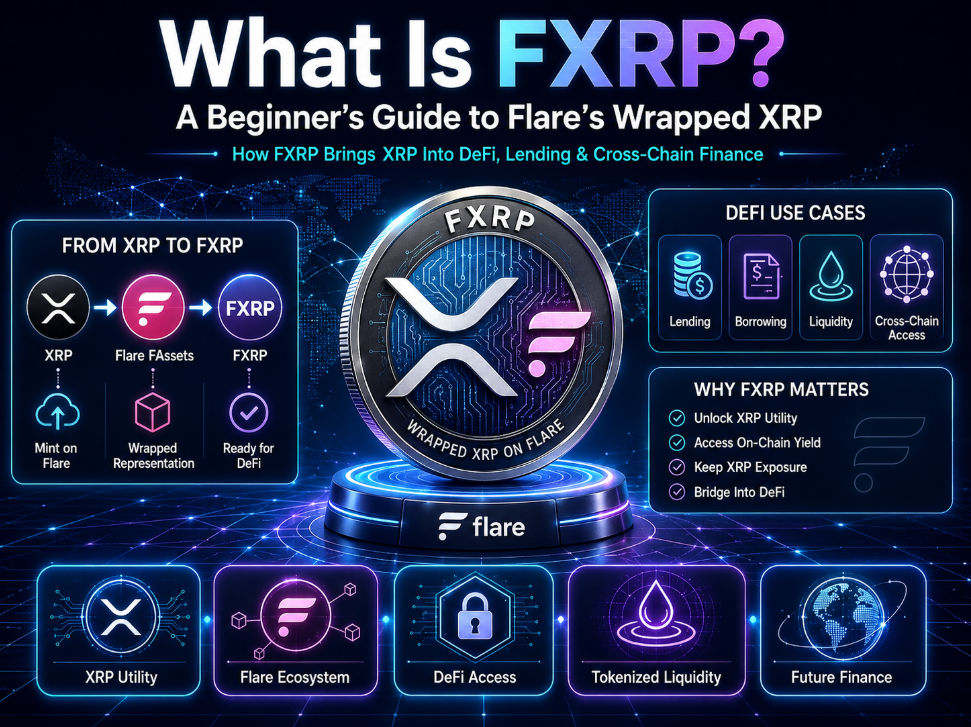
Many users, when they see FXRP, naturally think of WBTC. That intuition is correct, but FXRP’s mechanism is not identical to standard custodial wrapped tokens.
The core logic of a wrapped asset is: the original asset remains on its native chain, but a corresponding representation is generated on another chain through some mechanism, allowing it to access more use cases.
For example, BTC runs natively on the Bitcoin network, while WBTC allows BTC to enter Ethereum DeFi.
Similarly, XRP runs natively on the XRP Ledger, and FXRP allows XRP to enter Flare and other smart‑contract‑compatible DeFi environments.
However, FXRP is not simply a “book entry” issued by a centralized custodian. Flare’s FAssets system includes mechanisms for collateral, agents, minting, redemption, and liquidation — all designed to bring non‑smart‑contract assets into the smart‑contract ecosystem. Flare’s official FAssets page explains that users can convert BTC, XRP, or DOGE into FAssets and use them in Flare DeFi platforms.
Therefore, the emphasis of FXRP is not “we issued another XRP,” but rather “we gave XRP new financial use cases.”
3. Why Couldn’t XRP Participate Directly in DeFi Before?
This section answers: Why does XRP need FXRP? Why couldn’t it just go straight into DeFi?
The XRP Ledger excels at payments and settlements. Its design has long revolved around fast transfers, low‑cost transactions, and asset issuance. For cross‑border payments, exchange transfers, and settlement scenarios, XRP offers clear advantages.
But DeFi requires a different infrastructure.
DeFi typically relies on smart contracts, collateral management, automated liquidations, oracles, liquidity pools, lending markets, and composable financial protocols. Ethereum became the core DeFi infrastructure because it has a mature smart‑contract ecosystem, developer tools, DeFi protocols, and deep liquidity markets.
In the past, XRP functioned more as a payment and settlement asset than as a DeFi collateral asset. If XRP holders wanted to participate in lending, yield generation, or liquidity strategies, they usually had to sell their XRP and swap into ETH, USDC, USDT, wBTC, or other DeFi‑native assets.
FXRP changes that path.
It aims to let XRP holders convert their XRP into a composable DeFi asset — without directly selling their XRP exposure — for use in collateral, lending, yield, and on‑chain strategies.
4. What Is Flare, and Why Is It the Bridge for XRP into DeFi?
This section answers: Why does FXRP need Flare?
Flare is a Layer‑1 network built for data and interoperability. One of its key goals is to enable assets that lack native smart‑contract capabilities or DeFi ecosystems to enter the smart‑contract world.
Flare plays three roles in the path of XRP into DeFi.
First, asset representation layer.
Through the FAssets system, Flare maps XRP to FXRP, allowing XRP to be used in smart‑contract environments.
Second, cross‑chain connectivity layer.
XRP runs natively on the XRP Ledger, while DeFi applications may run on Flare, Ethereum, or other EVM ecosystems. Flare is responsible for forming verifiable, mintable, and redeemable connections between these assets.
Third, DeFi compatibility layer.
As an ERC‑20 asset, FXRP can more easily integrate with lending protocols, liquidity pools, yield vaults, and other smart‑contract applications.
A simple path to understand:
- XRP Ledger
- ↓
- Flare FAssets
- ↓
- FXRP
- ↓
- Flare DeFi
- ↓
- Ethereum DeFi
- ↓
- Morpho, RLUSD, Lending, Liquidity
Flare’s official FAssets documentation also notes that minted FAssets can be used in DeFi applications on Flare or bridged to other chains.
5. What Are FAssets, and Why Are They Core to FXRP?
This section addresses: Flare FAssets explained.
FAssets is an asset mapping system designed by Flare to bring non‑smart‑contract assets into DeFi.
“Non‑smart‑contract assets” here include XRP, BTC, DOGE, and others that were not originally built around EVM smart contracts. They have substantial market capitalization and user bases, but their DeFi use cases have been relatively limited.
FAssets attempts to solve several problems:
- How can these assets enter smart‑contract applications without leaving their native chain value foundation?
- How can users convert assets like XRP into on‑chain composable assets?
- How can collateral, minting, and redemption mechanisms maintain the asset peg?
- How can FXRP be lent, borrowed, collateralized, and used for liquidity in DeFi?
Flare’s developer documentation shows that the FAssets system includes an Asset Manager contract, which mints and burns FXRP and manages collateral and backing funds.
Thus, FAssets is not an ordinary cross‑chain bridge. It is a comprehensive issuance, verification, collateralization, and redemption framework designed specifically to bring non‑smart‑contract assets into DeFi.
6. How Is FXRP Generated? A Step‑by‑Step Process
This section answers: How does my XRP become FXRP?
From a user perspective, the FXRP generation process can be simplified into four steps.
Step 1 – The user holds XRP.
The user’s wallet holds native XRP on the XRP Ledger.
Step 2 – Initiate minting through the Flare FAssets system.
Following FAssets rules, the user sends XRP to a designated path, using a memo or destination tag to mark the receiving address on the Flare side. Flare’s official direct‑minting documentation explains that FXRP direct minting works by sending an XRPL payment to the FXRP Core Vault, with the Flare‑side recipient encoded in the memo.
Step 3 – The system generates FXRP.
After confirming the payment and parameters, the FAssets system mints the corresponding FXRP on the Flare side.
Step 4 – FXRP enters the DeFi ecosystem.
Once the user receives FXRP, they can transfer, trade, collateralize, lend, borrow, or deploy yield strategies using supported DeFi protocols.
A more visual path:
- XRP
- ↓
- Flare FAssets
- ↓
- FXRP
- ↓
- Lending, Collateral, Liquidity, Vaults
It is important to note that FXRP minting is not a casual copy‑and‑paste of XRP onto another chain. It relies on the collateral, verification, and redemption mechanisms of the FAssets system.
7. What Is the Collateral Mechanism Behind FXRP?
This section answers: Why isn’t FXRP just a simple copy of XRP?
For FXRP to maintain value, the market must trust that 1 FXRP closely tracks the value of 1 XRP. This requires an asset‑backing mechanism.
Flare’s FAssets framework includes collateral, agents, the Asset Manager, the Core Vault, minting, and redemption. Flare’s official FAssets page describes FXRP as a 1:1, over‑collateralized representation of XRP.
The core objectives of this mechanism are:
- When a user mints FXRP, there is corresponding XRP and collateral structure behind it.
- When a user redeems FXRP, they can go through the system to get back native XRP on the original chain.
- When risks arise, liquidation or collateral rules protect the asset peg.
Flare’s Core Vault documentation also explains that the XRP Core Vault is a multisignature account on the XRP Ledger, controlled by audited Flare smart contracts to execute related transaction instructions.
This shows that FXRP’s security depends not only on XRP itself but also on the FAssets contracts, the Core Vault, agent mechanisms, collateral assets, data verification, and the redemption process.
8. How Does FXRP Maintain Price Parity with XRP?
This section answers: Why is 1 FXRP ≈ 1 XRP?
FXRP aims to track XRP’s price closely, rather than forming an entirely independent price.
Three main mechanisms support the price peg.
First, the minting mechanism.
When users can mint FXRP using XRP, the supply of FXRP expands with demand, and arbitrageurs can exploit price differences.
Second, the redemption mechanism.
Flare’s developer documentation explains that redeeming FAssets means burning FAssets (e.g., FXRP) on Flare and receiving the corresponding value on the native chain (e.g., XRP on the XRPL).
Third, market arbitrage.
If FXRP trades significantly above XRP, arbitrageurs may mint FXRP and sell it.
If FXRP trades significantly below XRP, arbitrageurs may buy FXRP and redeem it for XRP.
In an ideal scenario, these mechanisms push FXRP’s price back toward parity with XRP.
However, investors must understand that pegs are not risk‑free. Any cross‑chain representation asset can face liquidity shortages, redemption delays, contract risks, bridge risks, or extreme market volatility.
9. How Does FXRP Enter Ethereum DeFi?
This section answers: Why does FXRP need Ethereum?
Ethereum is one of the most critical DeFi infrastructures today. A vast number of lending protocols, DEXs, liquidity pools, stablecoin markets, and structured yield protocols run on Ethereum and its compatible ecosystems.
For FXRP, if it were confined to Flare, its addressable market would be limited. If it can enter Ethereum DeFi, it gains access to deeper liquidity, more mature lending protocols, and a broader range of stablecoin markets.
Ethereum’s ecosystem offers robust DeFi infrastructure, including lending, DEXs, liquidity pools, vaults, stablecoins, and collateral markets. Users can observe overall DeFi trends on Ethereum via ETH price predictions.
Once FXRP enters Ethereum, its primary use cases fall into three categories.
First, Lending.
Users can deposit FXRP into supported lending markets to earn interest or use it as part of other strategies.
Second, Collateral.
Users can use FXRP as collateral to borrow stablecoins or other assets.
Third, Liquidity.
Users can add FXRP to liquidity pools, contribute to trading depth, and potentially earn fees or incentives.
In this way, XRP evolves from a pure holding/transfer asset into one that can participate in on‑chain financial strategies.
10. What Is the Biggest Difference Between FXRP and XRP?
This section addresses: FXRP vs XRP.
XRP is the native asset, running on the XRP Ledger. Its strengths are fast transfers, low fees, and suitability for payments and settlements.
FXRP is the DeFi representation of XRP, operating within smart‑contract ecosystems like Flare. Its strength lies in accessing lending, collateralization, liquidity pools, and DeFi strategies.
- XRP is for payments and native holding.
- FXRP is for DeFi composability.
- XRP is the base asset.
- FXRP is a financialization tool for XRP.
Therefore, FXRP is not a replacement for XRP; it is an extension of XRP’s utility. Users should not view FXRP as “a new XRP,” but rather as “a composable representation that lets XRP enter DeFi.”
11. FXRP + Morpho + RLUSD: A Real‑World XRP Lending Example
This section answers: How does FXRP actually help XRP holders obtain liquidity?
Morpho is a DeFi lending infrastructure. It features modular markets, risk isolation, and market‑specific collateral/borrow asset configurations. In February 2026, Flare announced the launch of XRP modular lending on Flare via Morpho and Mystic. FXRP holders can deposit FXRP into yield vaults or use FXRP as collateral to borrow stablecoins or other assets. Each Morpho market consists of one collateral asset and one loan asset, with risks isolated at the market level.
This is highly significant for XRP holders.
In the past, if a user needed stablecoin liquidity, they typically had to sell XRP for USDT, USDC, or another stablecoin.
Now, FXRP offers an alternative path:
- User holds XRP
- ↓
- Generate FXRP via FAssets
- ↓
- Deposit FXRP into a supported lending market
- ↓
- Borrow stablecoins
- ↓
- Obtain liquidity
- ↓
- Still retain XRP price exposure
This is the core logic of “XRP lending with FXRP”: you can get stablecoin liquidity without directly selling your XRP.
12. How Can FXRP Be Used as Collateral to Borrow RLUSD?
This section answers: How does the FXRP‑Morpho‑RLUSD mechanism work?
RLUSD is a Ripple‑associated USD stablecoin, which can serve as a lending asset, medium of exchange, and liquidity tool in DeFi. According to public reports from August 2026, FXRP has been added to Sentora’s RLUSD Main vault lending scenarios, allowing users to borrow RLUSD through isolated markets on Morpho Blue using FXRP as collateral — thus obtaining stablecoin liquidity without selling their XRP exposure.
This flow can be visualized as:
- User
- ↓
- XRP
- ↓
- FXRP
- ↓
- Deposit into Morpho Market
- ↓
- Borrow RLUSD
- ↓
- Use Stablecoin Liquidity
The greatest value of this structure is that XRP holders can access dollar‑denominated stablecoin funds without exiting their XRP position — for trading, DeFi participation, risk management, or other on‑chain strategies.
But it also introduces new risks. Whenever lending and collateral are involved, there are always collateral ratios, liquidation thresholds, price volatility, interest rate fluctuations, and liquidity risks.
13. What Is RLUSD, and Why Is It Suitable as a Borrowing Asset?
RLUSD plays the stablecoin role in this lending structure. Stablecoins in DeFi primarily provide a relatively stable unit of account, a medium for lending/borrowing, and a liquidity tool.
For XRP holders, borrowing RLUSD offers the benefit that you don’t have to sell XRP to obtain dollar liquidity; instead, you can use FXRP as collateral and borrow a relatively stable asset.
This model resembles the logic of a collateralized loan in traditional finance:
- You don’t sell your asset.
- You pledge it as collateral.
- You receive working capital.
If the asset price remains stable and the collateral ratio stays healthy, you can maintain your original asset exposure.
However, if XRP’s price declines, the value of the FXRP collateral drops, and the user may face margin calls or liquidation risk.
14. What Does FXRP Mean for the XRP Ecosystem?
This section answers: Does FXRP change XRP’s value proposition?
The biggest significance of FXRP is that it expands XRP from a payment asset into a financial asset.
In the past, XRP’s primary narratives were payments, cross‑border transfers, settlements, and exchange liquidity.
In the future, if FXRP, FAssets, Morpho, RLUSD, stablecoin lending, and on‑chain yield markets continue to develop, XRP could have many more DeFi use cases.
Think of it this way:
Past XRP
→ Payment
→ Settlement
→ Trading
Future XRP
→ Collateral
→ Lending
→ Yield
→ Liquidity
→ Structured DeFi
Flare officially refers to this direction as XRPFi — the on‑chain financialization of XRP. In a May 2026 article, Flare noted that by bringing XRP as active capital to Flare, XRP can be deployed, lent, staked, traded, used as collateral, and integrated into vault strategies.
This does not mean XRP will necessarily appreciate because of FXRP, but it does meaningfully expand XRP’s use cases.
15. Potential Ecosystem Changes Driven by FXRP
FXRP could drive three major developments.
First, XRP Lending.
XRP holders can enter lending markets via FXRP, depositing FXRP to earn yield, or using it as collateral to borrow stablecoins.
Second, XRP Liquidity.
As FXRP enters DeFi, more trading pairs, liquidity pools, and arbitrage paths can form, increasing on‑chain liquidity for XRP‑related assets.
Third, XRP Financial Applications.
In the future, we may see yield vaults, structured products, stablecoin lending, leveraged strategies, insurance products, and composable assets built around FXRP.
In a May 2026 article about the MXRPY multi‑strategy yield vault, Flare noted that the vault deploys FXRP into return engines such as options trading, basis and funding rate arbitrage, and on‑chain XRPFi strategies.
This illustrates that FXRP’s direction is not merely “wrapping an asset,” but integrating XRP into a more complex on‑chain financial system.
16. What Does FXRP Have in Common with Other Tokenized Assets?
This section answers: How does FXRP relate to RWA, wrapped assets, and on‑chain financialization trends?
FXRP is part of the broader financialization of crypto assets.
“Financialization” here means taking assets that were previously only held or transferred and bringing them into lending, collateral, yield, portfolio strategies, and liquidity markets.
This parallels the RWA (Real‑World Assets) trend. RWAs bring traditional assets — such as stocks, ETFs, bonds, commodities, or real estate — onto blockchains. FXRP does something similar: it brings a native crypto asset (XRP) into the DeFi financial system.
You can read about what AIRH is to understand how AI Robotics and RWA assets enter on‑chain finance. Whether traditional assets or crypto assets, the future competitive edge may not just be price, but whether the asset can be used within financial systems.
FXRP’s value lies here as well: it turns XRP from a “tradable asset” into a “composable financial asset.”
17. How to Analyze FXRP’s Investment Value? What Metrics Matter?
This section answers: Does FXRP have investment value?
Strictly speaking, FXRP itself is not an independent investment vehicle; it is a representation of XRP. Its core goal is to track XRP’s value and expand XRP’s utility.
Therefore, analyzing FXRP is not like analyzing a typical new token based purely on price movements. A more reasonable framework looks at three categories of metrics.
First, Adoption.
Watch FXRP supply, the volume of XRP converted, the number of wallets interacting with DeFi, the amount of FXRP used in lending protocols, yield vault sizes, and collateral demand.
If FXRP supply grows consistently and a significant portion is actively deployed in lending, liquidity, staking, or vault strategies — not sitting idle — that suggests rising XRPFi adoption.
Second, Liquidity.
Monitor market depth on Flare, Ethereum, and other ecosystems; DEX trading volumes; lending market sizes; stablecoin borrowing demand; and liquidation liquidity.
Deeper liquidity makes FXRP more acceptable to DeFi protocols as collateral.
Third, Security.
Evaluate the FAssets mechanism, smart‑contract audits, Core Vault operations, cross‑chain bridge risks, oracle risks, redemption mechanisms, and liquidation processes.
FXRP’s opportunity comes from DeFi composability, but its risks also stem from DeFi complexity.
18. Comparing FXRP with Other Crypto Asset Financialization Trends
This section answers: How is FXRP different from other ways assets enter financial ecosystems?
FXRP and WBTC share a commonality: both allow a native asset to enter a new smart‑contract ecosystem.
- WBTC brings BTC into Ethereum DeFi.
- FXRP brings XRP into Flare and beyond.
However, their underlying mechanisms, custody models, collateral structures, ecosystem goals, and risk profiles differ. Users should not assume that because both are “wrapped assets,” their risks are identical.
FXRP also differs from ETH.
- ETH is a native smart‑contract asset and a core asset of Ethereum DeFi.
- XRP, by contrast, enters smart‑contract ecosystems through FXRP — meaning it requires a representation layer and cross‑chain mechanism to become composable.
FXRP also differs from emerging crypto projects.
For example, what is SKYAI leans more toward AI crypto and on‑chain data applications; what is GRVT is more about Web3 trading infrastructure; what is SESTRI is better analyzed as a new token and Web3 ecosystem play. Users can also observe early‑stage, small‑cap token performance through FRONG price charts and FRONG price predictions.
Going forward, crypto competition will not be just about token prices — it will be about whether an asset can enter the financial system, serve as collateral, generate liquidity, and be accepted by DeFi protocols.
19. Risk Analysis of FXRP: What to Watch Out for When Entering DeFi
This section improves E‑E‑A‑T by covering not only opportunities but also risks.
First, cross‑chain risk.
FXRP involves the XRP Ledger, Flare, potential Ethereum bridges, and DeFi protocols. Any cross‑chain asset can face smart‑contract vulnerabilities, bridge failures, delays, redemption anomalies, or contract upgrade issues.
Second, FAssets mechanism risk.
FXRP relies on the FAssets system’s collateral, agent, Core Vault, minting, and redemption mechanisms. If the system design, contract implementation, or operational processes have flaws, they could affect FXRP minting, redemption, or price parity.
Third, liquidation risk.
If a user uses FXRP as collateral to borrow RLUSD or other stablecoins, a decline in XRP’s price reduces the collateral ratio. If it falls below the protocol’s requirement, the user may be liquidated.
Fourth, liquidity risk.
If FXRP market depth is shallow, users may face slippage, reduced borrowing efficiency, or difficulty exiting positions when buying, selling, collateralizing, or redeeming.
Fifth, interest rate risk.
Lending market rates fluctuate with supply and demand. If borrowing costs rise after taking a loan in RLUSD, the user’s holding cost increases.
Sixth, operational risk.
Minting FXRP, bridging, depositing into lending protocols, setting collateral ratios, and managing health factors are more complex than simply holding XRP. Newcomers unfamiliar with DeFi processes can easily make mistakes with addresses, memos, networks, approvals, or collateral ratios, leading to losses. Flare’s official troubleshooting documentation reminds users to double‑check the Core Vault address, amount, recipient encoding, and memo format before minting; otherwise, the payment may not be correctly recognized or FXRP may be minted to the wrong path.
20. How Can XRP Holders Use FXRP Safely?
If you are an average XRP holder, consider this sequence before using FXRP.
First, confirm whether you really need DeFi.
If you are simply holding XRP in cold storage long‑term and do not need lending, yield, or stablecoin liquidity, you may not need to use FXRP at all. DeFi offers opportunities but also adds complexity.
Second, start with a small test.
When minting FXRP, bridging, or depositing into a DeFi protocol for the first time, use a very small amount first. Verify that the address, memo, wallet, network, and protocol flow are correct before moving larger amounts.
Third, understand collateral ratios.
If you borrow RLUSD using FXRP, you must understand LTV, liquidation thresholds, health factors, and price volatility. Do not push your collateral ratio too high.
Fourth, diversify risk.
Do not convert all your XRP to FXRP, and do not put all your FXRP into a single protocol. Cross‑chain, lending, yield, and stablecoin activities all carry different risks.
Fifth, follow official announcements.
FAssets, Flare Smart Accounts, Morpho, Sentora, RLUSD, and cross‑chain paths may all be upgraded. Always refer to official documentation and protocol pages first. Do not trust private messages from strangers or unverified tutorials.
21. FAQ: Frequently Asked Questions About FXRP
What is FXRP?
FXRP is a representation of XRP on the Flare ecosystem, designed to bring XRP into DeFi applications. In short, FXRP is a composable representation of XRP within the Flare ecosystem, enabling XRP to participate in lending, collateralization, liquidity, and smart‑contract applications.
Is FXRP the same as XRP?
No. XRP is the native asset, running on the XRP Ledger. FXRP is a representation of XRP on the Flare ecosystem, aimed at expanding XRP’s DeFi utility.
What is the biggest difference between FXRP and XRP?
XRP is primarily used for payments, settlements, and native transfers. FXRP is primarily used for DeFi — such as collateral, lending, liquidity provision, and yield strategies. FXRP is not a replacement for XRP; it expands XRP’s use cases.
Can FXRP earn yield?
Yes, provided that there are DeFi applications that support FXRP. In February 2026, Flare announced the launch of XRP modular lending via Morpho and Mystic, allowing FXRP holders to deposit FXRP into yield vaults or use it as collateral to borrow stablecoins and other assets.
Can FXRP be used as collateral?
Yes. In lending markets that support FXRP, it can be used as collateral. Public reports show that FXRP has already been integrated into Morpho and RLUSD lending scenarios, allowing XRP holders to obtain stablecoin liquidity by pledging FXRP.
Does FXRP replace XRP?
No. FXRP is not a new XRP, nor is it a substitute for XRP. It is a representation that enables XRP to enter the DeFi ecosystem.
Is FXRP safe?
FXRP’s safety depends on multiple layers: the XRP Ledger, Flare FAssets mechanisms, the collateral system, the Core Vault, smart contracts, cross‑chain paths, and the DeFi protocols themselves. It offers more financial utility, but it is also more complex than simply holding XRP.
How does FXRP work?
Users convert XRP into FXRP through the Flare FAssets system. FXRP can then be used on Flare or other supported ecosystems. To redeem, users burn FXRP on Flare and receive corresponding XRP through the system.
What is FXRP collateral?
FXRP collateral refers to using FXRP as collateral in a lending protocol. After depositing FXRP, users can borrow RLUSD, stablecoins, or other assets in supported markets, but they must maintain a sufficient collateral ratio to avoid liquidation.
22. Summary: FXRP Transforms XRP from a Payment Asset into a DeFi Financial Asset
The core meaning of FXRP can be summed up in one sentence: It is not a new XRP, but a bridge for XRP to enter the DeFi world.
In the past, XRP was primarily seen as a payment asset, settlement asset, and trading asset. It is fast, cheap, and widely held, but its use in DeFi lending, collateral, yield, and smart‑contract composability was relatively limited.
Through Flare FAssets, XRP can be represented as FXRP and enter a broader range of DeFi scenarios. FXRP can be used for lending, collateral, liquidity, yield vaults, and many more on‑chain financial applications.
For XRP holders, the greatest value of FXRP is: you may obtain DeFi liquidity and yield opportunities without directly selling your XRP.
For DeFi users, the greatest value of FXRP is: a major crypto asset like XRP is now entering the collateral and lending markets.
For infrastructure researchers, FXRP represents a larger trend: crypto assets are moving from simple holding and trading into an era of asset financialization.
But behind the opportunities lie risks. FXRP involves cross‑chain mechanics, smart contracts, collateral, lending, liquidation, and liquidity. Ordinary users must understand the mechanisms, start with small test amounts, manage collateral ratios, and always refer to official documentation.
If FXRP can continue to grow adoption, deepen liquidity, expand into more DeFi protocols, and maintain a secure and stable minting/redemption framework, it may become a critical piece of infrastructure for bringing XRP into on‑chain financial markets. In the future, the key competitive edge in crypto will not just be which token rallies fastest, but which assets become more efficient, more secure, and more composable financial tools.